What is a Dragee? The Art of Chocolate-Enrobed Confectionery
One small, glossy, perfectly rounded bite. You hear the faint snap of chocolate, feel the crunch of a roasted nut beneath it, and then — a slow, layered warmth. That is a dragee. And behind that one bite is a craft that has taken 2,000 years to perfect.

What is a Dragee, Exactly?
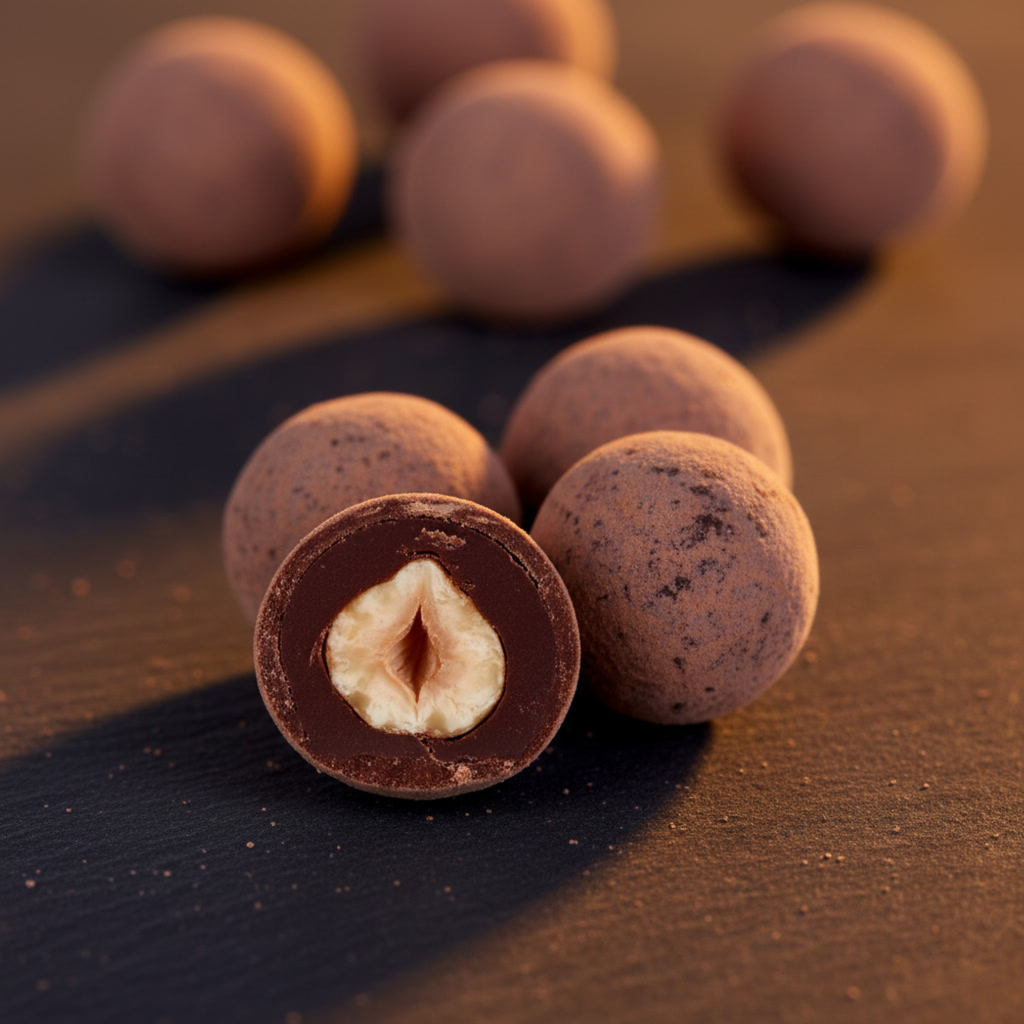
The word dragee (pronounced dra-ZHAY) comes from French, and it describes one of the oldest and most refined categories of confectionery in the world: a center ingredient — typically a nut, dried fruit, or roasted coffee bean — that has been coated in layer upon layer of chocolate or sugar until it forms a smooth, round, glossy confection.
That definition might sound simple, but the reality of a well-made dragee is anything but. The center must be chosen for its flavor compatibility with the coating. The chocolate must be tempered (a precise heating and cooling process that gives chocolate its shine and snap). The coating must be applied in dozens of thin, even layers. And the finish must be polished until the dragee catches light like a small jewel.
In everyday conversation — especially in India — you might hear dragees referred to as chocolate-covered almonds, enrobed nuts, or chocolate-coated dry fruits. Those terms are broadly accurate, but they do not capture the craft behind a true dragee. A mass-produced chocolate-covered almond and a handcrafted Belgian-couverture dragee share the same basic idea the way a factory-stitched shirt and a bespoke suit share the concept of clothing.
Quick Answer: What is a Dragee Chocolate?
- A dragee is a confection made by coating a center (nut, fruit, coffee bean) in multiple thin layers of chocolate or sugar using a rotating drum called a panning machine.
- The word is French and the craft dates back to medieval Europe — with roots in Ancient Rome.
- A properly made dragee has a smooth, uniform, glossy shell and a perfectly audible snap when bitten.
- The center ingredient remains fully intact inside — you get distinct layers of flavor: the outer chocolate coating, then the nut (or fruit), with its own character.
- Artisan dragees use couverture-grade chocolate (minimum 31% cocoa butter) — the same chocolate used by French and Belgian patisseries.
The History of Dragee — From Ancient Rome to Artisan Chocolatiers
The dragee has a longer history than most foods you will encounter in any confectionery shop today. Its story begins not in France, but in Ancient Rome — where a confectioner named Julius Dragatus is credited with first coating almonds in honey to create a sweet, preserved treat for celebrations. That small act of coating a nut in something sweet and protective set the template for everything that followed.
Medieval France: When Sugar Became the Coating
The story takes its pivotal turn in 13th-century France, in a northeastern town called Verdun. When Crusaders returned from the Holy Land, they brought sugar to Europe — then an extraordinarily expensive and medicinal substance. An apothecary in Verdun, looking to make bitter medicines easier to swallow, began coating pills and herbs in hardened sugar. He called these sugar-coated preparations dragées. The town of Verdun became famous across France for this invention, and dragées de Verdun became a sought-after delicacy at aristocratic celebrations, weddings, and church ceremonies.
By the 15th century, sugar-coated almonds had become so strongly associated with celebrations that they were a standard gift at French weddings and christenings — a tradition that persists to this day in parts of Europe and the Middle East, where sugar dragees are distributed to guests as symbols of fertility and good fortune.
The 19th Century: Chocolate Enters the Picture
For several centuries, the dragee remained a sugar-coated confection. Then came the great transformation of the 19th century, when chocolate became widely available and chocolatiers began experimenting with it as a coating medium. The challenge was significant: chocolate behaves very differently from sugar syrup in a panning drum. It melts at body temperature, it must be precisely tempered to achieve gloss, and it requires careful temperature control throughout the layering process.
Those who mastered it created something new: the chocolate dragee. By the late 1800s, chocolate-panned almonds and hazelnuts were appearing in Belgian and French confiseries. In Belgium, the Vanparys family in Brussels — founded in 1769 — had already built an entire business around dragees, and they refined the craft of chocolate-panning into a recognized art form.
"The dragee carries more history than almost any other confection. Every time a handcrafted chocolate-enrobed almond is placed in a gift box, it carries 2,000 years of celebration behind it."
The Modern Era: From Smarties to Artisan Revival
The 20th century saw the dragee go in two very different directions simultaneously. On one side, mass manufacturers adapted the panning process to create iconic products: Smarties (1937), M&Ms (1941), and later, the entire category of candy-coated chocolate. These made the panning concept accessible to everyone, but at the cost of quality — compound chocolate, artificial flavoring, and industrial scale replaced couverture, single-origin cocoa, and craft.
On the other side, artisan chocolatiers in France, Belgium, and increasingly around the world kept the original craft alive — using real couverture chocolate, premium nut centers, and the patient, time-consuming panning process. Today, the artisan dragee market is experiencing a significant revival, particularly in India, where a new generation of chocolate buyers is moving beyond mass-market brands toward handcrafted, story-led confections.
How a Dragee is Made: The Panning Process Explained
Making a dragee is one of the most technically demanding processes in the world of chocolate. Unlike a truffle (which is hand-rolled) or a chocolate bar (which is poured into a mold), a dragee is built up incrementally — layer by layer — over many hours. The process is called panning, named for the rotating drum (called a bassina in Italian) at the center of the operation.
Here is what happens at our place in Jalandhar, from raw almond to finished dragee:
Selecting and Roasting the Center
Everything begins with the center ingredient. For our almond dragees, we use whole almonds that are dry-roasted to a precise level — enough to deepen the flavor and remove surface moisture, but not so much that the natural oils are destroyed. Moisture is the enemy of a clean panning process; even a slightly damp center will prevent the chocolate from adhering properly.
Tempering the Couverture Chocolate
Our chocolate — Callebaut Belgian couverture — must be tempered before it enters the panning drum. Tempering means heating the chocolate to around 45°C to melt all the cocoa butter crystals, then cooling it to 27°C to allow stable crystals to form, then raising it slightly to 31–32°C for working temperature. This precise process is what gives our dragees their audible snap, high gloss, and smooth mouthfeel. Untempered chocolate turns dull and waxy.
Pre-coating (Sealing the Center)
Before any chocolate goes on, the almond centers are often pre-coated with a thin layer of cocoa butter or confectioner's glaze. This seals the surface of the nut and prevents its natural oils from migrating into the chocolate coating — a problem that causes fat bloom (grey patches) on the finished dragee over time.
The Panning Process — Layer by Layer
The sealed almonds go into the rotating panning drum. Small amounts of tempered liquid chocolate are added while the drum turns, evenly distributing the chocolate across every almond. Cool air is then blown through the drum to set each thin layer — this takes several minutes. Then more chocolate is added, more cool air, and so on. A typical artisan dragee goes through 25 to 40 of these cycles before the coating reaches the right thickness. Rushing this process produces dragees with thick, uneven, cracked coatings. Patience is non-negotiable.
Polishing and Finishing
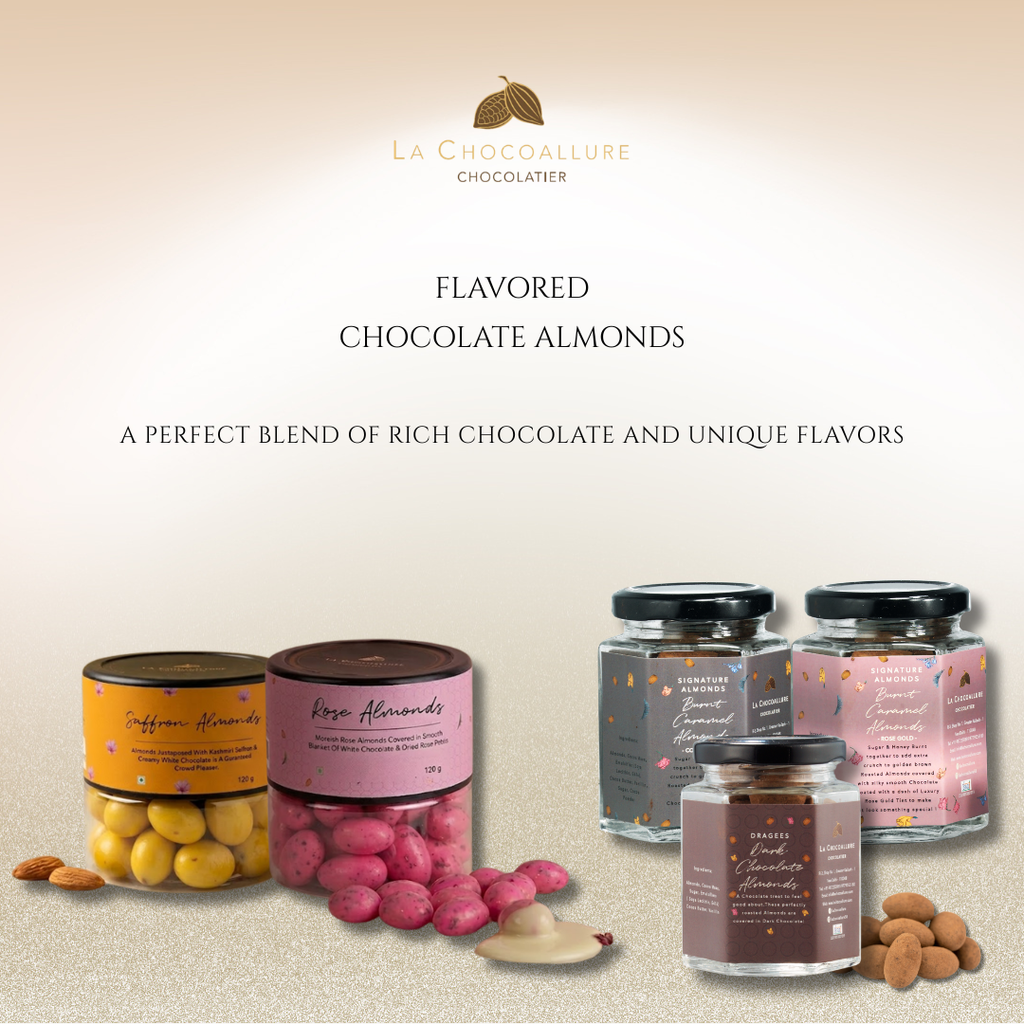
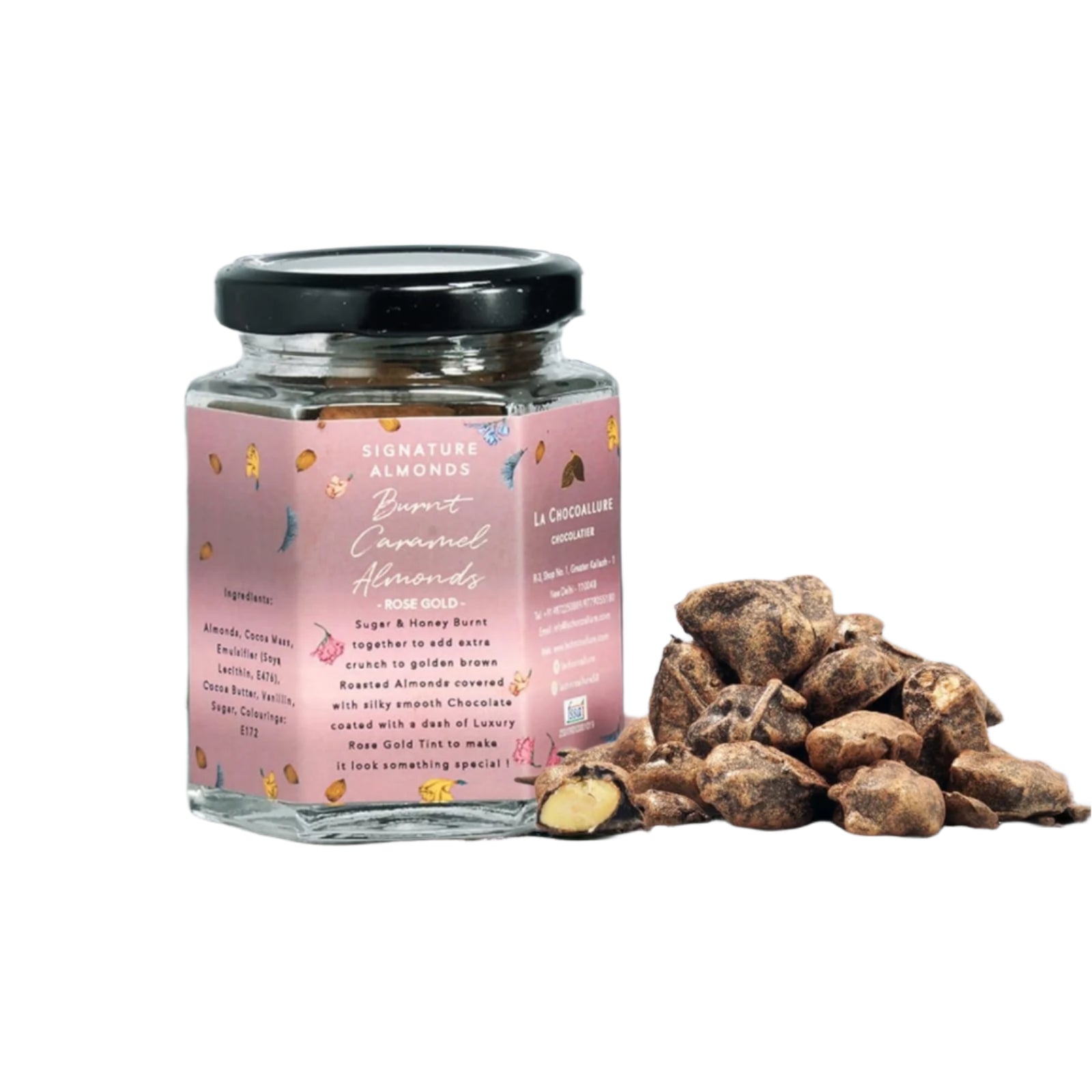
Once the chocolate coating is built up to the right thickness, the dragees enter a polishing phase. A small amount of carnauba wax or food-grade shellac is added to the drum and the dragees are tumbled until the friction creates that characteristic high-gloss surface. For specialty dragees like our Rose Gold Burnt Caramel Almonds, an additional coloured or metallic luster dust is applied at this stage — the source of their distinctive appearance.
Quality Check and Packaging
Each batch is inspected for uniformity, gloss, and weight. Dragees that show any cracking, blooming, or irregular shape are removed. The approved dragees are then packaged in our signature containers — sealed to protect against humidity, which is the primary threat to dragee quality in India's climate.
⏱ How long does it take?
A single batch of artisan dragees — from raw almond to finished, packaged confection — takes between 8 to 14 hours of active work across two days, plus resting time. This is why genuine artisan dragees cost significantly more than mass-produced alternatives. You are not just paying for ingredients. You are paying for skill, time, and attention that cannot be automated without destroying the result.Types of Dragees — A Guide to Centers, Coatings, and Finishes
Not all dragees are the same. The category is rich and varied, defined by the combination of center, coating, and finishing technique. Understanding these variations helps you appreciate what makes each dragee unique — and choose the right one for gifting or personal indulgence.
By Center Ingredient
| Center | Flavor Profile | Best Paired With | Occasion Fit |
|---|---|---|---|
| Almonds | Mild, slightly sweet, clean crunch | Dark chocolate, burnt caramel, rose | Universal — works for all occasions |
| Hazelnuts | Rich, buttery, deeply nutty | Milk chocolate, praline, dark chocolate | Festive, celebratory gifting |
| Coffee Beans | Bitter, bold, aromatic | Dark chocolate, espresso couverture | Corporate gifting, connoisseur sets |
| Dried Cranberry / Mango/Pineapple | Tart, fruity, vibrant | White chocolate, milk chocolate | Summer gifting, hampers |
| Pistachio | Savory-sweet, distinctive green note | White chocolate, rose, cardamom | Premium luxury gifting |
| Chia Seeds (whole) | Neutral, slightly earthy | Dark chocolate | Health-conscious gifting, snacking |
By Chocolate Coating
Dark chocolate dragees are the purest expression of the form. The bitterness of cocoa and the sweetness of the nut or fruit create a natural contrast that experienced palates find deeply satisfying. The higher the cocoa percentage, the more complex and intense the flavor. Our dark chocolate dragees use Callebaut couverture at 54–70% cocoa solids depending on the product.
Milk chocolate dragees are warmer, softer, and more accessible in flavor. They are ideal for gifting to those who find pure dark chocolate too intense. The caramel notes in good milk couverture pair beautifully with toasted hazelnuts and almonds.
White chocolate dragees offer the most delicate profile — creamy, vanilla-rich, and sweet. When paired with tart dried fruits (mango, cranberry, strawberry), white chocolate dragees achieve a complex interplay of sweet and sour that is genuinely surprising. Our Mango White Chocolate Dragees use Alphonso mango for a specifically Indian flavor identity.
By Finish
The finish of a dragee — what you see and touch before you taste — tells you a great deal about the craft behind it. A high-gloss finish (achieved through carnauba wax polishing) signals careful panning and professional technique. A matte cocoa-dusted finish creates a more rustic, intense look. A metallic or luster-dusted finish (as seen on our Rose Gold Burnt Caramel Almonds) is the most visually dramatic and requires the most post-panning skill to apply evenly.
Artisan Dragee vs. Mass-Made Chocolate-Covered Nut — What's the Actual Difference?
This is one of the most common questions we get at La Chocoallure, and it deserves a direct, honest answer. When you pick up a chocolate-covered almond at a supermarket and a handcrafted dragee from an artisan chocolatier, you are not just paying a price difference. You are eating two fundamentally different things.
| Factor | Artisan Dragee (La Chocoallure) | Mass-Produced Chocolate-Covered Nut |
|---|---|---|
| Chocolate type | Callebaut couverture (min. 31% cocoa butter) — the same grade used by French patisseries | Compound chocolate (vegetable fat replaces cocoa butter) — cheaper, waxy mouthfeel |
| Coating layers | 25–40 individual thin layers, each set by temperature-controlled air | 1–3 dips in melted compound chocolate |
| Texture | Smooth, uniform shell with a clean snap; no thick or cracked areas | Often thick, uneven coating; may crack or chip; no real "snap" |
| Gloss | True polish from panning — each dragee reflects light evenly | Dull or artificially lacquered appearance; no natural gloss |
| Flavor | Complex and layered — the chocolate's cocoa origin, the nut's roast level, and any added flavoring all register distinctly | One-dimensional sweetness; the nut is often barely perceptible beneath a thick, sugary coating |
| Ingredients | Whole roasted nut, single-origin couverture, natural flavoring only | Partially hydrogenated oils, artificial flavor, stabilizers, fillers |
| Shelf life | 45–90 days in proper storage — no preservatives needed because the technique itself preserves | 6–18 months — achievable only through preservatives and processed ingredients |
The difference is not marginal. It is the difference between a confection made by trained hands using real ingredients and a product optimized for shelf life, distribution, and margin. Both have their place — but only one belongs in a gift that represents a real occasion.
What's Inside a Dark Chocolate Dragee? The Ingredient Story
One of the reasons dark chocolate dragees have grown rapidly in popularity among discerning Indian consumers is that they occupy a rare space: a treat that is genuinely indulgent yet built on real, recognizable ingredients. Let us look honestly at what is inside a premium dark chocolate almond dragee.
The Almond
Almonds are among the most nutritionally dense nuts available. They are a natural source of Vitamin E, magnesium, healthy monounsaturated fats, and fiber. Roasting deepens their flavor considerably, though it slightly reduces some heat-sensitive nutrients. In a dragee, the almond provides the crunch, the structure, and a quiet sweetness that balances the bitterness of dark chocolate.
The Dark Couverture
Good dark couverture chocolate (54–70% cocoa solids) contains four core ingredients: cocoa mass, cocoa butter, sugar, and lecithin (a natural emulsifier from soy or sunflower). Nothing artificial is needed. Dark chocolate at this cocoa percentage is naturally rich in flavanols — antioxidant compounds found in cocoa beans that have been the subject of extensive nutritional research. While we are not in the business of making health claims, we are honest that a dragee made from real dark couverture is a very different proposition from a candy bar made from compound chocolate.
💡 A Note on Chia Seed Almonds
Our Dark Chocolate Chia Seed Almonds are worth a specific mention here. Chia seeds are embedded into the outer chocolate shell of each almond during the panning process, creating an unusual texture — a slight crunch within the chocolate coating itself — and adding omega-3 fatty acids to an already nutritionally respectable confection. It is one of our most innovative products and a particular favorite among health-aware gifters. → Explore our Chia Seed Almonds.Why Dragees Make the Finest Chocolate Gift
In India, gifting is not a casual act. Whether it is Diwali, Rakhi, a corporate milestone, a wedding, or simply a gesture of appreciation — the gift carries meaning, and its quality reflects the regard you have for the recipient. This is why dragees, when made well, are one of the most thoughtful chocolate gifts possible.
They Travel Exceptionally Well
Truffles are exquisite, but they are fragile — temperature-sensitive, short-lived, and prone to damage in transit. Dragees, with their protective chocolate shell, are far more robust. They can travel across India without refrigeration (within their temperature range), making them ideal for sending gifts by courier or carrying them on a flight.
They Have a Generous Shelf Life
A well-made dragee stored properly lasts 45 to 90 days without any preservatives. This means the recipient can enjoy them at their own pace, without the pressure of consuming them within a day or two. For corporate gifting especially, this matters — a Diwali hamper that arrives on October 15 should still be perfect when someone reaches for it on November 5.
They Look as Good as They Taste
The visual quality of a dragee — particularly our rose gold and metallic-finished varieties — is immediately apparent. In the age of social media gifting, a beautiful dragee jar creates a moment. Recipients photograph them before opening them. They share the unboxing. That extends the gift's impact beyond the moment of giving.
They Tell a Story That Mass Chocolates Cannot
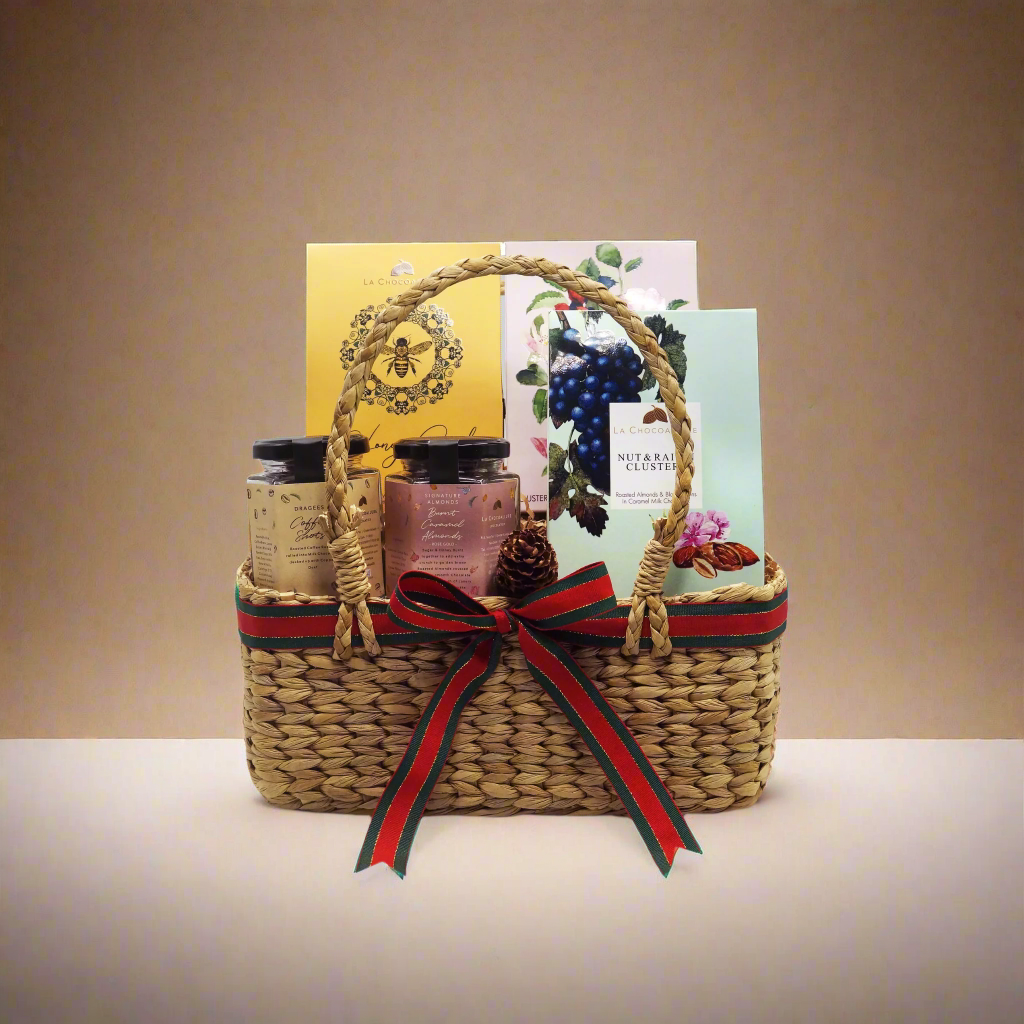
When you give someone a box of La Chocoallure dragees, you are not just giving them chocolate. You are giving them a Belgian-trained craft, single-origin cocoa, roasted almonds dressed in hand-polished couverture — a product that took two days to make in small batches in Jalandhar. That story has value. It elevates the act of gifting from a transaction into a gesture.
How to Taste a Dragee Properly
This might sound unnecessary — it is chocolate; you eat it. But a well-made dragee rewards a little deliberateness.
Start by holding one between your fingers for a few seconds and feeling the smooth, cool shell. Place it on your tongue and resist the urge to immediately bite down. Let the chocolate shell begin to melt just slightly — this releases the first aromatic compounds from the couverture. Then bite cleanly through the shell. Notice the snap. Then notice the transition: the chocolate coating gives way to the nut, which has its own texture, its own warmth from roasting, its own flavor notes.
A dark chocolate dragee with a good almond will typically give you three distinct moments: the initial bitterness and bloom of dark chocolate aromatics, then the natural sweetness and crunch of the roasted almond, then a lingering finish — warm, slightly tannic, with a clean fade. If you are getting all three, the dragee was made well.
Pair with: A small cup of unsweetened black coffee, a Darjeeling first flush tea without milk, or a glass of still water. Milk and sweet drinks compete with the chocolate's aromatics rather than complementing them.
Storing Dragees: What You Need to Know
The enemy of a dragee is not time — it is humidity and temperature fluctuation. Here is what to do and what to avoid:
| Factor | The Right Approach | What to Avoid |
|---|---|---|
| Temperature | 16°C to 20°C is ideal. A cool room away from direct sunlight is perfect. | Avoid temperatures above 25°C — the chocolate begins to soften and the dragee loses its gloss and snap. |
| Refrigeration | Only if absolutely necessary (in peak Indian summer), and only in an airtight container. | Do not refrigerate without sealing — condensation causes sugar bloom, a white/grey coating that affects texture and appearance (though not safety). |
| Sealing | Always close the container fully after taking some out. Our jars are designed to seal properly. | Leaving them exposed to air causes them to lose their gloss and absorb ambient odors. |
| Sunlight | Store in a drawer, cabinet, or box away from windows. | Direct sunlight causes fat bloom and color degradation in both the chocolate and any metallic finishes. |
| Duration | Consume within 60–90 days of purchase for best flavor and texture. | Do not store beyond the printed best-before date — unlike wine, dragees do not improve with age. |
La Chocoallure Dragees: Our Craft, Your Experience
We have been making dragees at La Chocoallure since our founding in 2010 — not as a side category, but as one of our signature crafts. Our team trained at the Callebaut Chocolate Academy and the Ecole School of Chocolate in France — institutions where panning and dragee production are core curriculum, not electives. That training is evident in every batch we produce from our place in Jalandhar.
"We don't make dragees to fill a product category. We make them because they are one of the most technically demanding things a chocolatier can produce — and getting them right requires the same discipline as any other serious craft."
— La Chocoallure, Jalandhar
— La Chocoallure, Jalandhar
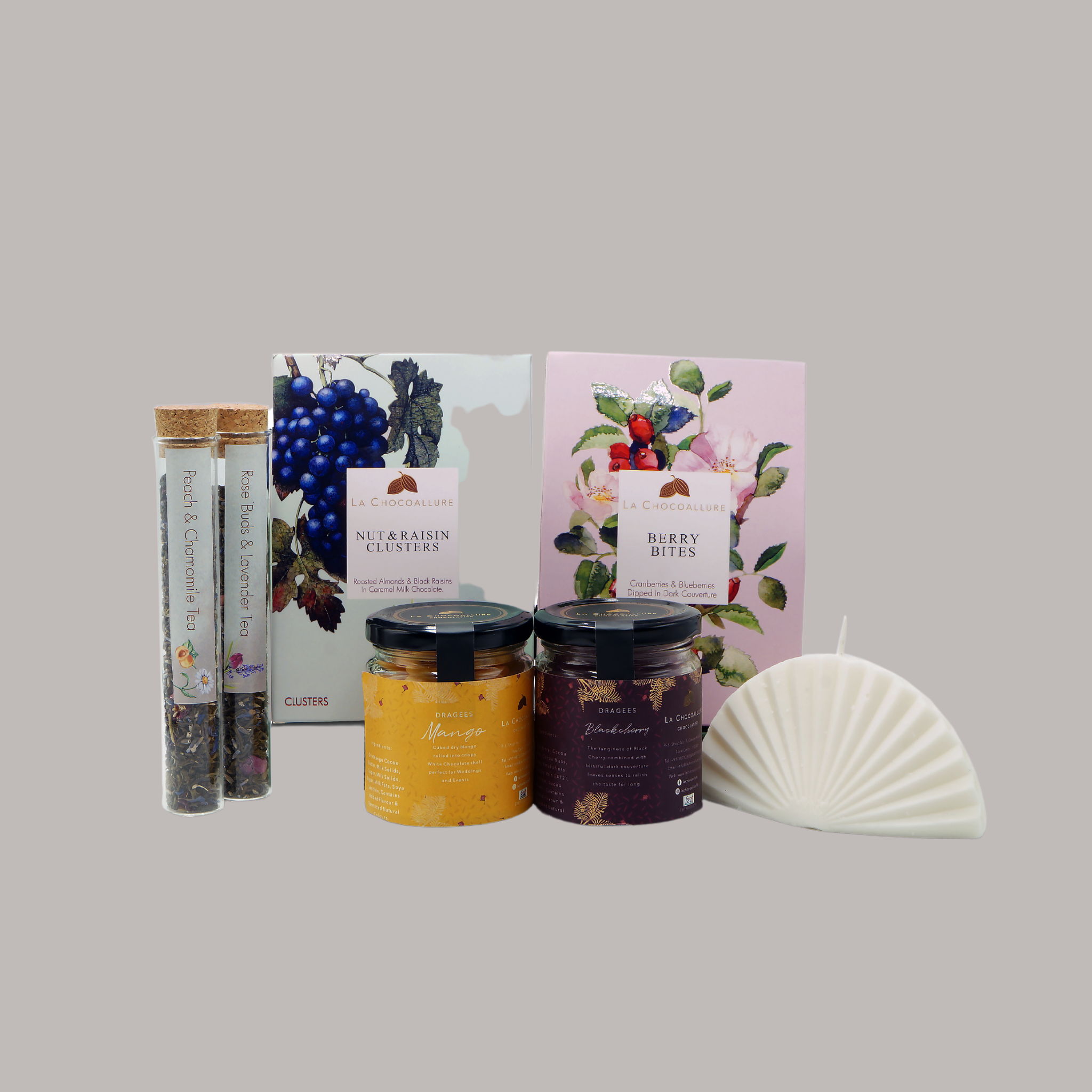
If you are considering dragees as a gift — for Diwali, for a corporate occasion, for a wedding, or simply because someone you know deserves something extraordinary — we invite you to explore our collection. Each jar, each box, each individually polished piece represents hours of work by hands that have spent years learning to get it right.
Related post
RECENT POSTS